


About the organisation
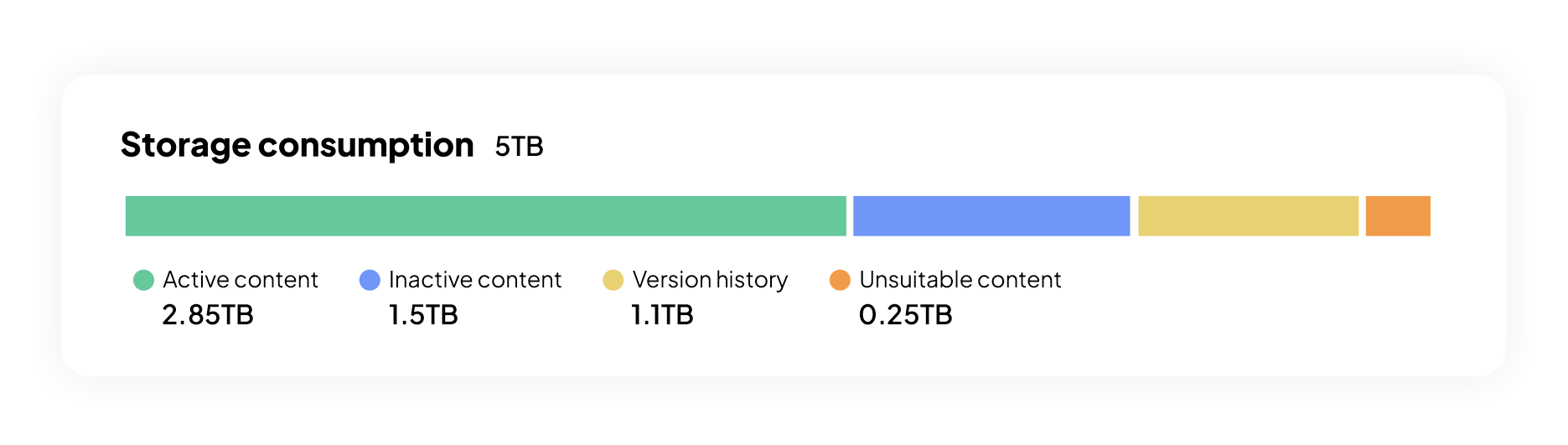
This firm operates in a setting where document control isn’t just operational - it’s existential. Every file could be relevant, every version potentially useful. SharePoint had become the central system for matter-related documentation, with a total footprint of roughly 5TB.
The challenge
The issue wasn’t that the firm didn’t understand storage growth. It was that any attempt to reduce it introduced risk. That created a familiar paradox: the team knew there was unnecessary data, but could not confidently act on it.
Files could not simply be deleted because they were old. Older content might still be relevant to retained case history, audit trails, or client-related obligations. That meant the cleanup strategy needed to not only be effective, but defensible.
“We weren’t comfortable deleting anything at scale without clear visibility and an audit trail, because the cost of getting it wrong was too high.”
What SProbot revealed
Once visibility improved, the storage footprint started to break down into clearer categories.
Version history for large files alone accounted for 1.1TB, which made sense given the volume of iterative document work in legal environments, and is one of the primary reasons tenants run out of storage.
At the same time, there was a significant accumulation of older matter data - files that had not been touched in years but still occupied expensive active storage.
Not everything belongs in SharePoint
Some of the simplest savings came from recognising when SharePoint had been used as a fallback storage layer.
Email archives in PST format, large collections of evidence files, and even small standalone databases had all found their way into document libraries.
These were removed or relocated, freeing 125GB and delivering a small $300 in savings, but more importantly reducing clutter and improving AI readiness.
Inactive content carefully handled
The key difference in this environment was how carefully inactive content had to be handled.
Archiving was the dominant strategy. Files were preserved but moved into a lower-cost tier, contributing the largest share of savings in this category. Deletion was used selectively, where duplication or irrelevance could be established with confidence based on SProbot's inactive file reports.
Security improved
One of the most important requirements within the firm was clear definition of ownership and guest access across the 315 sites in the tenant.
SProbot's health check revealed that there were 40+ sites with an unexpectedly high guest user count. Further investigation showed that these guest users were granted access via sharing links which were against company rules. This enabled the IT team to make the necessary policy and setting adjustments, and clean up existing links using SProbot's sharing link report.
Results
Total annual savings: $3 900
The firm's investment in SProbot was $1 175, with a clear return on investment on top of a fundamental improvement in data readiness for Copilot implementation.
In summary
This case is useful because it highlights something a lot of legal and compliance-conscious organisations already suspect: storage waste is rarely just a technical issue. It is usually a classification issue.
Once the stakeholders could distinguish between version bloat, content not suitable for SharePoint, inactive material better suited to archive, and inactive material that could be deleted, the cost picture changed. More importantly, the cleanup process became something the team could defend.